

Welcome to the BENCHES BIODIVERSITY
ASSESSMENT TOOL FOR SPORT
Partners







About the tool
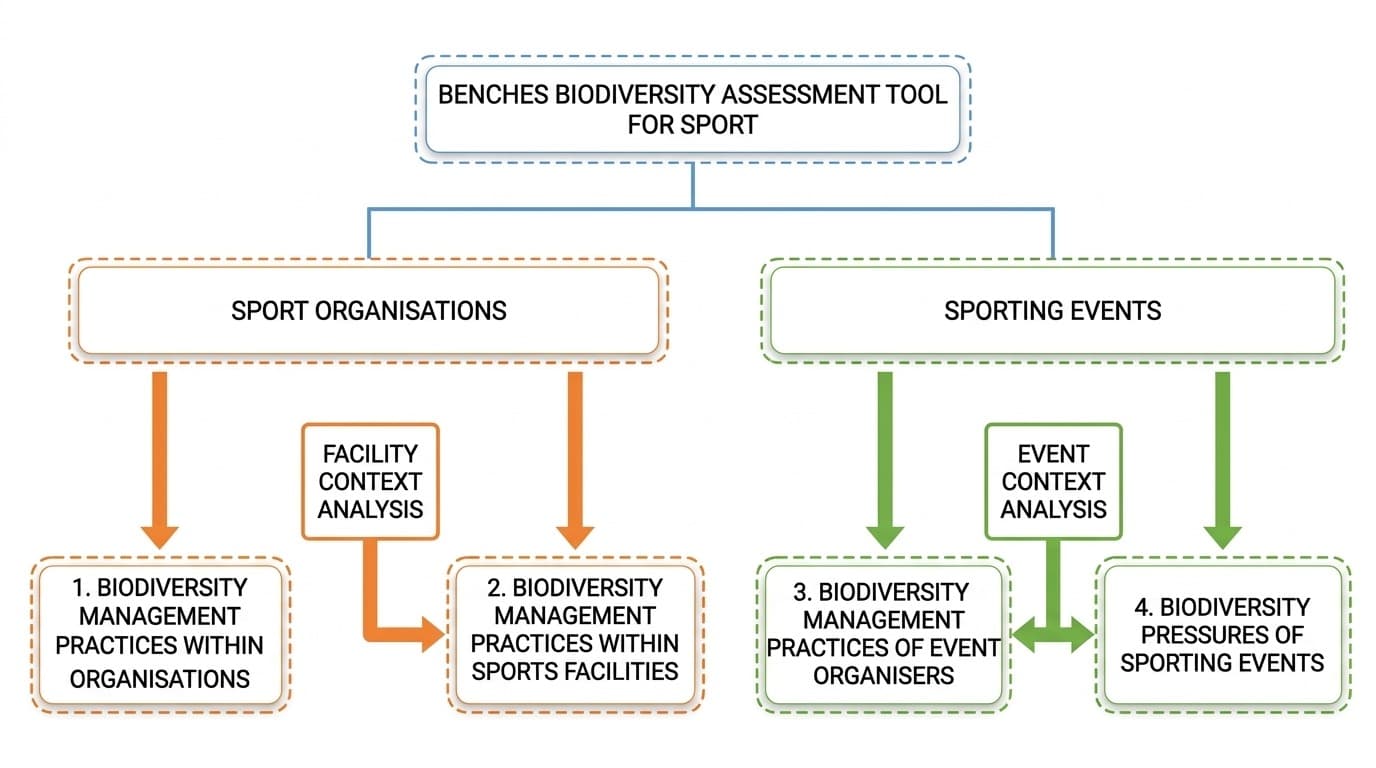
The BENCHES biodiversity assessment tool for sport helps sports organisations and event organisers identify, measure, and mitigate their biodiversity impacts across the entire value chain and different ecosystems. It is designed for easy use by practitioners without specialist knowledge and is structured around four independent axes that can be used separately or together for flexible yet comparable assessments over time and across contexts:
Axis 1 - Biodiversity management within sports organisations.
Axis 2 - Biodiversity management within sports facilities.
Axis 3 - Biodiversity management by event organisers.
Axis 4 - Biodiversity pressures of sporting events.
The tool also includes a context analysis that considers how close facilities and event sites are to protected areas, key biodiversity areas, or large urban green spaces, which can increase the weight of local impacts and add extra management questions. Finally, it adapts assessments based on the ecosystem type (aquatic, terrestrial, or urban), adding ecosystem-specific questions for events.
Assessment flow




How it works
The BENCHES biodiversity assessment tool for sport is meant to be used periodically, to monitor your progress and support continuous improvement. Event organisers are encouraged to use the tool both during the planning phase, to minimise potential impacts, and immediately after the event, to assess its actual impact.
It follows four main steps:
1. Profiling
Specify the sport, the ecosystem, and the focus of your assessment. If you want to assess the impact on biodiversity of your facility or event, indicate its location in the context analysis
2. Biodiversity assessment
Based on the selected evaluation axes, you can assess your biodiversity management practices through a series of KPIs.
3. Results
The results of the assessment will be graphically displayed as percentage of the maximum achievable score, with each axis having its own distinct maximum score. The results will be represented both for individual axis evaluations and as an aggregated score derived from multiple axes.
4. Improvements opportunities
Based on the results of your assessment, you will gain an understanding of improvement opportunities in biodiversity management.